
Being adaptable
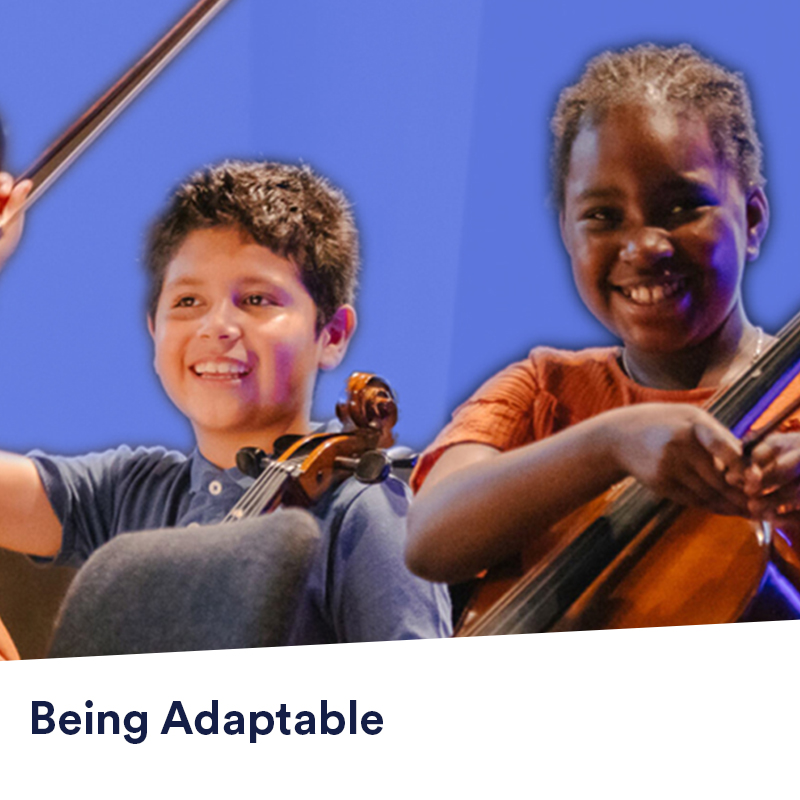
When working with children and young people, it is essential to be adaptable and responsive to the participants, so that they can take the lead in the creative process. For Many Voices: Ensemble, composers and teachers found themselves adapting to the group’s need for support, fluctuating energy levels, varied engagement, diverse imaginations and individual capabilities, often resulting in a greatly improved child-led experience.
Watch the video to hear how this challenge presented itself to our composers and read more about how to approach similar potential challenges below.
Prepare to go further
This project was the first time Tom Poster (Lullaby and Waddle for Puffin) had led a composition workshop with children in a school environment. Tom commented on how he quickly realised the importance of being adaptable in your plans, as you never know how a group may engage in the activities.
In this case, Tom was surprised by how quickly the children completed some of the activities he had planned for the session. Although it’s great to make sure you have enough time for activities, you also must anticipate that children may reach their goal or potentially exhaust their possibilities much quicker. It’s best to consider how you might “level up” an activity for those children or young people that take to it more quickly than you’d expected.
On the flipside, you may not get as far as you hoped, so preparing to work at different paces – fast and slow – is a wise move. Consider where there might be room for flexibility in your plans.
The kids got through some of the activities far faster than I’d expected, which meant that I felt the second half of the workshop became considerably less focused as I frantically tried to rack my brain for new strategies to keep them engaged!
I feel if I did it again, I’d need to come up with more because there were things that I thought would take, you know, half an hour to do this one improvisation and 5 minutes later they’d all come up with these brilliant ideas. And I was really just trying to keep up.
And I think I would say as advice to anyone doing this sort of thing, never underestimate the brilliance and quickness of young people’s imaginations and how much they’ll run with something and how quick you need to be yourself to keep up with them. – Tom Poster
Change of plans
Rūta Vitkauskaitė (The Storm) found that she had to fully adapt her workshop plans on the spot, as when the group came back after lunch, they were struggling to engage due to lapsed energy levels. This had drastic effects on the creative process.
Being unafraid to take the risk of doing something more relaxed or purely for fun may help reset the minds of the participants and eventually focus their creative flow back to the task on hand. This is exactly how Rūta approached the issue, to great success as her decision made the workshop even more impactful.
Being prepared with a diverse toolkit of games, equipment and relaxed activities might help as a much-needed detour during your work with children and young people. This could be games and activities appropriate for different moods, atmospheres, ages, skillsets etc., choosing from them as the workshop or project develops and your understanding of the group evolves.
My biggest challenge was when after the break, the children came back and were just in a completely different state of mind (quite tired, and a bit grumpy – that might have been because they did not get to go outside because of the rain).
I wanted to work on something quite focused, but I immediately decided to skip it and go straight into games and drawing. That worked out well in the end, but I had a quiet panic inside for a good 10 minutes…
If I did this again, I would also divide all my activities by energy level – energising, calming, for tired people, for excited and energetic people, for focused people, etc… I would then pick the ones suitable for any given moment and situation, instead of running them according by schedule, which I did at first and that did not work that well… – Rūta Vitkauskaitė
Providing structure
Being adaptable to your group doesn’t mean coming without a plan. Composer Blasio Kavuma (What’s for dinner?) arrived to his first workshop with a plan for a more ‘open’ form of facilitation, which ultimately meant that the children and young people struggled to explore key musical aspects that are required for developing a musical composition.
He ended up having to take on a more active role in steering the compositional process, causing tension with the child-led approach that he had worked so hard to facilitate. As well as this, he found that the children were working at varied musical abilities and knowledge levels, so realised it would have been more effective to create activities that engage with this diversity of experience and skills, and didn’t assume prior knowledge.
This is where considering ‘adaptive teaching’ and differentiation may help with planning your approach to activities – this is your understanding that participants may come with varying levels of skill, knowledge, experience and planning with that in mind. It is important to strike a balance between having a structure that can enable and support children and young people to explore and learn about specific parts of the compositional process, alongside the openness for them to contribute their own skills, ideas and preferences to the music-making process, at whatever level of experience they have.
I think what I would do differently next time is I would adapt the activities to different levels a little bit more rigorously. I think it was quite clear that some of the children were much further on than others, even though they’re still very much in the early stages. I think having a more stratified approach to the activities is important for the future.
In hindsight, some of the activities (like making a melody together in small groups) needed more structure, such as using a specific scale or rhythmic idea, to get clearer and more furtive results. I think my approach was to kind of give them an idea of what to do and then see what they come up with. But it ended up being quite chaotic.
So, for example, when I wanted them to come up with melodies in small groups, I just wanted them to come up with their own notes and use those notes to build a melody, but it just didn’t really work. I think next time I would definitely say to them, you know, “use E D A”, or “you can use the open strings”, or “you can use the first five notes of the major scale” – just have something like that to get them going. Otherwise, they didn’t really know what to do. – Blasio Kavuma
What questions should I consider?
- How can I provide structure and flexibility at the same time?
- What parameters do I want to set in place that within them allow for creative freedom?
- How can I prepare for different eventualities, depending on the response of the group/children/young people?
- What might I need to be on the lookout for to assess energy levels, engagement and participation throughout the activities?
- How can I prepare myself for when things may not go to plan?
What does success look like?
- There are more child-led opportunities in the session
- You feel confident and backed up by a plan that works in multiple eventualities
- Children are engaged and motivated, enjoying the activities
- You avoid feelings of failure, increasing chances of success and feelings of achievement
- You quickly recognise when something is not working and have a plan to counter this